Participants will:
- Consider the Woodcraft Folk Aims and Principles
- Identify issues which are important to them, bearing in mind those aims and principles
- Consider aspects of their life which they would like to change • Explore ways of speaking up and effecting change
- Learn about activists, including trade unionists, who have made a difference
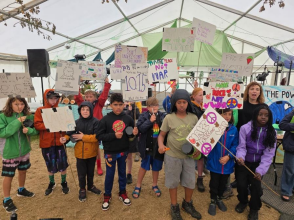
- Make their own placards about issues they care about
Participants will develop:
- Knowledge of working together to make a difference
- Understanding of what can be changed
- History of activism – within trade unions and other collective action • Speaking clearly, effectively and being heard
- Ways to challenge injustice, inequality and intolerance by being active and working collectively
- Assertiveness
Materials
Some information about historic protestors (e.g. Rosa Parks, Nelson Mandela, Chartists, Suffragettes, National Union of Mineworkers, Grunwick strikers). Pictures of protests with placards on display, stiff card (A3 or A2), bamboo/garden stakes or similar, strong tape or a wall stapler, art materials (paint, pens, etc.)
Before you start
Spread card and art materials out across tables. Have bamboo and tape ready at a couple of stations.
What to do
Gather the participants together and start by asking who is aware of the Woodcraft Folk aims and principles. Read out and/or display a copy of the aims and principles. Discuss how Woodcraft Folk is committed to cooperation, social justice and changing society for the better.
Discuss how change happens and give some examples of people or movements in history who have had to protest in order to bring change – e.g. Rosa Parks, Nelson Mandela, the Chartists, Suffragettes. Move the discussion onto the question of what the participants would like to change.
Explain that they will have an opportunity to make placards to display arguments, images or slogans about the issue they care about. Talk about how they would make these visual and share some pictures of protests with placards visible. This whole discussion should take maybe 20min.
For the next part of the sessions, support the participants to make placards about the issue they wish to protest about, using the card and art materials. When these are complete, they can be attached to the bamboo/garden stakes using strong tape or a wall stapler. This art activity is an ideal opportunity to talk to the participants about Woodcraft values, social change and the things that matter to them.
Leave 20min or more at the end of the session to arrange a ‘protest’ with the placards the participants have made. This could be in the space you meet in, with facilitators playing the role of press and photographing /videoing the protest, or it could take place in a local park or open space. If the participants are a little older and have a single issue they care deeply about, you might even arrange for them to visit a relevant site for their protest, e.g. the town hall or a local picket line. This would take some advance planning but will make the experience even more meaningful for the group and link more directly to real-world action.