
This workshop supports learning how to and gaining confidence to resist evictions.
Materials
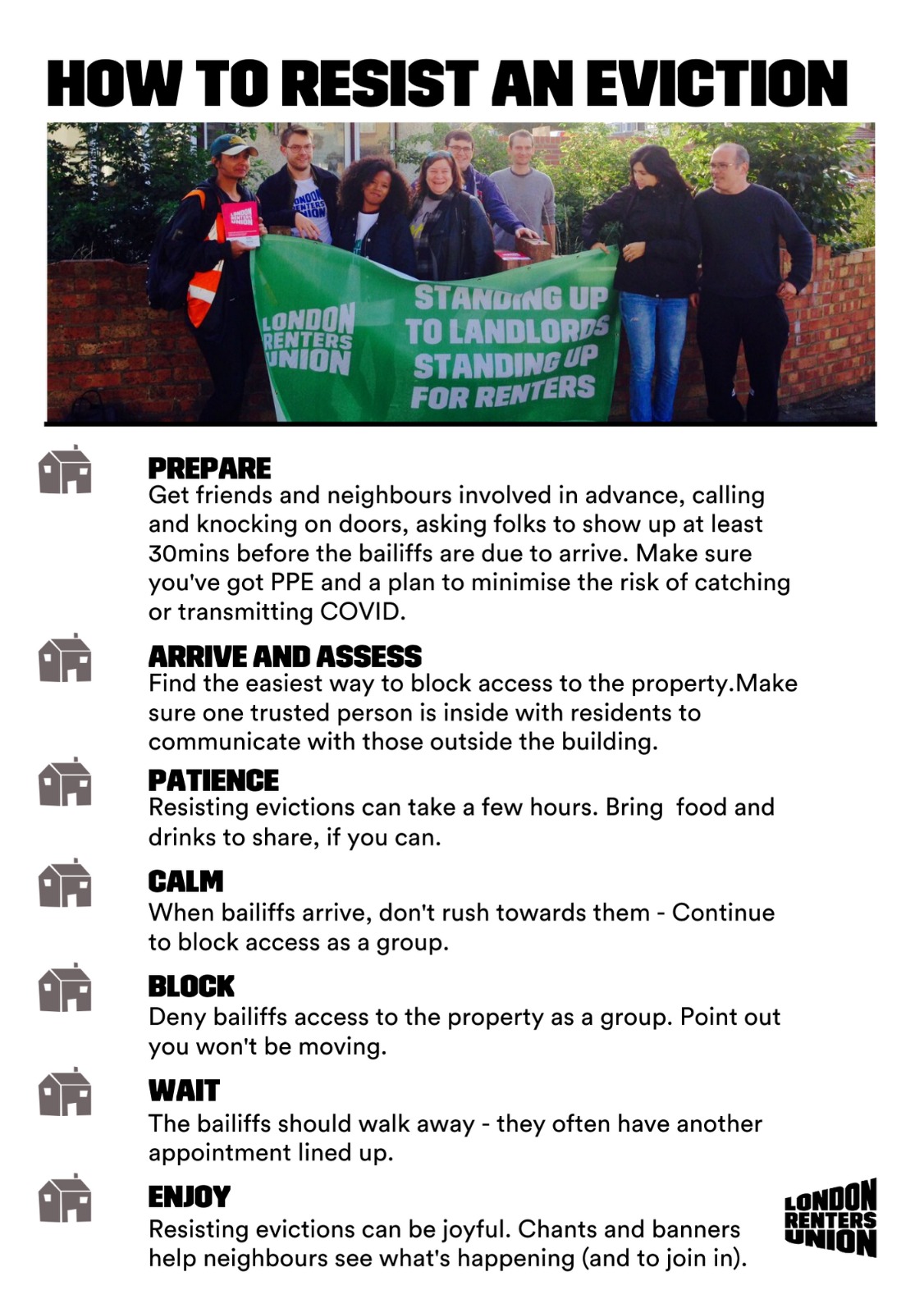
What to do in eviction poster, Eviction Resistance Role Play cards
Before you start
Print role cards and poster
What to do
Start the session with some quiz questions. You can do this in a circle or label parts of your meeting space and participants can move to show their answers.
History and theory of private property
Quiz (e.g. how many evictions happened this year, rent cost rise)
End with:
If you are a private renter, when can your Landlord evict you?
1. When you damage the property
2. When you are in rent arrears
3. Just because they want to
Answer is all the above!
Explain to the group this highlights ‘No fault’ Section 21 evictions – A Section 21 notice, often called a “no-fault” eviction, allows a landlord to end an Assured Shorthold Tenancy (AST) without providing a reason, giving the tenant a date to leave the property. You can read more about it to give the group more information here.
How much can your Landlord raise your rent by?
- 3%
- 25%
- 200%
Again all the above!
Explain to the group this highlights lack of rent caps – A rent cap is decided by the government as a legal limit on how much a landlord can increase rent in a time frame such as yearly. These caps are most common in social housing, protecting tenants from large rent increases, though proposals for caps in private rentals are sometimes discussed. The primary goal of a rent cap is to improve housing affordability and provide tenants with financial stability by preventing excessive or unfair rent hikes.
What happens in an eviction
Explain clearly the steps of what to expect in an eviction (use the poster to help you). You don’t need to be detailed about the different kinds (section 28, 21 etc) but you can add that detail if it comes up and look at the rights of tenants in this video.
The steps are (roughly):
- A tenant receives notice of an eviction on a certain day
- The tenant tells their tenants union about it
- The union agree to take on their case and resist the eviction
- On the day of the eviction, are ready to go
- On notice that the bailiffs are coming, everyone gathers outside their house
- The eviction resistance takes place
- The bailiffs go home
- The appeals to the landlord to not evict the tenants can continue
Ask the group who they think is involved in an eviction?
- What are the roles people might have?
- What else might you need?
- What might you do if the police arrive?
Then explain the different roles for the role play (Use the role playing cards to hand out to participants)
Bailiffs (2 where possible) – Bailiffs are people employed by landlords and estate agents to remove someone from their home or work space. You’ve been working a long shift and just want to get through the day as quickly and easily as possible. You get paid just for showing up at the house. You are easily put off by protesters, and don’t need another extra stress of being shouted at.
Tenant Supporter – Your role is to help the tenant feel less isolated and scared. You’ll be there inside the house, making cups of tea, offering emotional support.
Police Liaison – You’re here to let everyone know what’s happening, and to warn the people inside if the police or other authorities show up. You stand outside the door to the building/room holding signs and making noise so everyone on the street/in the corridor knows what’s going on. If the police or other authority turn up, you speak to them and politely explain what you’re all doing in the slowest way possible. Your goal is to wait until the bailiffs give up.
Bailiff Liaison – Your role is to be the main communication with the bailiffs, you want to convince them that this eviction job is not worth their effort. Talk in a calm but firm manner to the bailiffs to convince them to leave.
Police Officer – As police officer you are the muscle of the state and those who have power (in this case landlords and estate agents). You have the power to arrest people you suspect are being violent. You want to get the protestors to go away by scaring them with threats. You will try to turn the protestors against each other by getting 1 to join your side
Protestors (more than 2 where possible) – You want to stop the eviction and let everyone in the community know what’s happening and encourage them to join the protest. Your role is to make as much noise and fuss as possible and physically block the bailiffs from entering. In order to not be arrested by the police you’ll need to find non-violent ways to be disruptive. You link arms and stop Bailiffs getting to the house.
Now the group are ready to start their role play. Explain that the scenario is an eviction from a private residence. Tell the group the outline (below) and let them be imaginative as to how they express this through their role play.
1) everyone gets in position – maybe use chairs or tables to create a front door
2) crowd outside the door start chanting
3) Bailiffs turn up and try to speak to people to get let in
4) Bailiff liaisons speak to them and calmly inform them that they won’t get in
5) Police officers show up and try to manipulate the crowd into leaving. They might try and arrest people and generally be threatening
6) Bailiffs and police get bored and leave – it’s not worth their time
7) Protestors celebrate
Repeat the role play a few times allowing different people to take on different roles.
Bring the group back together for a discussion. Ask the group to reflect on:
- How did it feel to be in each of these roles?
- What did you find difficult?
- When did you feel most powerful?
- How confident would you feel doing this in real life?
- How can we support those facing eviction?
- One word check out for how you’re feeling.


Photo credit: Michael Preston